
Fast-Moving vs Slow-Moving Medicines: How to Identify and Act
Quick Answer
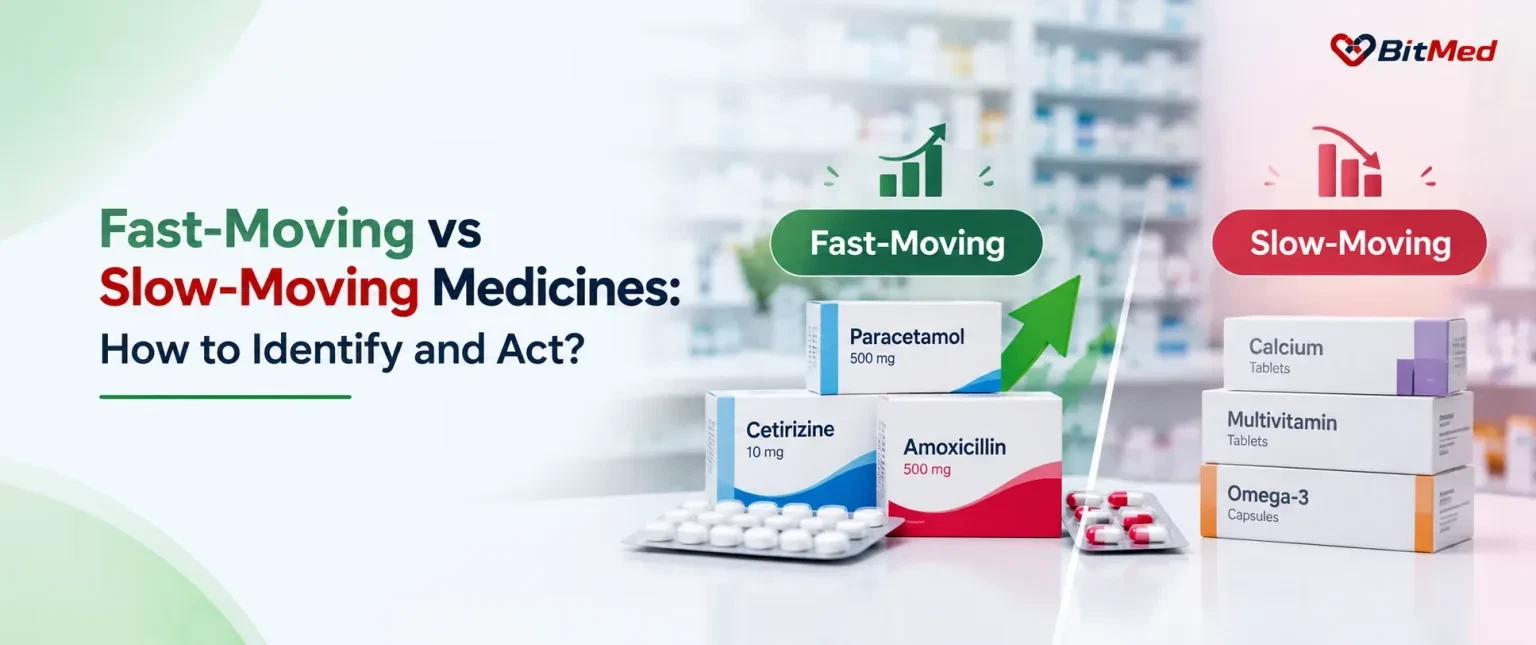
Fast-moving medicines sell often and turn over quickly. Slow-moving medicines sell rarely and can sit on the shelf for months, ageing towards an expiry date the whole time. You separate them with three analyses that each measure something different, and you need all three because a cheap medicine can still be one a patient cannot go without.
- FSN analysis: Measures how fast an item sells. It ignores price entirely.
- ABC analysis: Measures how much money the item ties up over a year.
- VED analysis: Measures how critical the item is to the patient in front of you.
Then act on the split: keep fast movers on automated reordering with real safety stock, buy slow movers in small lots, and dispense everything by FEFO — First Expired, First Out. In India there is one more clock running. If near-expiry stock goes back on a supplier's credit note, the GST on it can only be adjusted if that credit note is declared by 30 November following the financial year of the original sale. After that, the credit-note route carries no GST, and the one left is returning the stock as a fresh supply on your own tax invoice, subject to your supplier's return terms. A slow mover left too long narrows your options as well as your margin.
Why Medicine Inventory Is Not Like Other Retail
In most retail, a stockout costs you one sale. In a pharmacy, a stockout of a vital medicine can put a patient at risk — and the patient who walks out for one missing item usually buys the rest of the basket somewhere else too. Overstocking has the opposite cost and it is just as real: it locks up working capital, and once a medicine crosses its expiry date it becomes a write-off and a disposal obligation at the same time.
That is why a single stocking policy applied across the whole shelf fails in both directions at once. Every SKU needs a rule derived from three facts about it: how fast it sells, how much money it ties up, and how badly a patient needs it. The rest of this article is how to get those three facts out of data you already have.
Fast, Slow and Non-Moving: What the Three Buckets Mean
| Category | What it means | What to do about it |
|---|---|---|
| Fast-moving (F) | Sells often, high turnover, rarely sits | Automate reorders, hold real safety stock, shelve within easy reach of the counter |
| Slow-moving (S) | Sells, but far more gradually than you ordered for | Order small lots, review monthly, watch the expiry date more than the sales figure |
| Non-moving (N) | No sales at all over your chosen review period | Return to the supplier, transfer to a branch that can sell it, or delist it |
There is no statutory cut-off between the three, so the thresholds are yours to set — and the important part is writing them down and applying them the same way every month. A common starting point borrowed from general stores management is the inventory turnover ratio: above 3 turns a year is fast and below 3 is slow. Non-moving is better defined by time than by turnover, as the next paragraph explains. Treat that as a first draft and then tune it against your own sales history.
One borrowed convention you should not import unchanged is the non-moving window. General inventory texts often call an item non-moving after 12 to 24 months of no consumption, because they are written for parts that do not perish. A medicine does. Most retail pharmacy stock that has not moved in about four months has no realistic path to selling before its batch expires, which is a far more useful line to draw — and the point at which a slow mover has quietly become dead stock.
In practice the fast movers in an Indian retail pharmacy are predictable: everyday antibiotics, antacids, paracetamol, and the chronic-therapy drugs for diabetes and blood pressure that come back on a monthly refill cycle. The slow movers are just as predictable once you look — specialty injectables, rare-disease drugs, uncommon strengths and dosage forms, and anything seasonal that is now out of season.
How to Identify Them: FSN, ABC and VED
1. FSN Analysis: Does the Item Move at All?
FSN analysis ranks items by how often they are issued and how long they sit in stock. It deliberately ignores price, which is its whole value: it answers one narrow question — does this item sell? — without letting an expensive item look important simply because it is expensive.
To run it, export 12 months of sales and stock movement from your billing software. For each SKU, calculate how many times it was issued and its average days in stock, then sort the list into F, S and N against the thresholds you wrote down. Run it batch-wise where you can: a fast-moving molecule can still be sitting on one stranded batch nobody has touched since March.
2. ABC Analysis: How Much Money Does It Tie Up?
ABC analysis follows the Pareto principle — a small share of your items accounts for most of your spending. To run it, multiply each item's annual consumption by its unit cost, sort the results from highest to lowest, and work down the list calculating the cumulative percentage of total spend.
| Class | Share of items (typical) | Share of spend (typical) |
|---|---|---|
| A | About 10–20% | About 70–80% |
| B | About 20–30% | About 15–20% |
| C | About 50–70% | About 5–10% |
A published analysis of 4,581 drug items at AIIMS New Delhi shows how this looks on a real catalogue: 1,003 items (22%) fell into Class A and consumed about 70% of the annual drug budget, 1,245 items (27%) in Class B took 20%, and 2,333 items (51%) in Class C took the remaining 10%. Note that Class A came out slightly wider than the textbook 10–20% band — which is the point of running the analysis on your own data rather than assuming the band.
3. VED Analysis: How Critical Is It?
VED is the analysis that stops the other two from hurting someone. It ranks items by clinical criticality rather than by money or velocity, and it is the reason you cannot manage a pharmacy shelf on spend data alone.
- Vital: A stockout risks death or serious harm. Hold generous safety stock and never let the reorder point be crossed unnoticed.
- Essential: A stockout degrades the quality of care but is not immediately dangerous. Moderate buffer, periodic review.
- Desirable: Used for minor or self-limiting conditions. Order as needed and accept the occasional gap.
In the same AIIMS study, 1,423 items (31.06%) were classified Vital, 2,758 (60.20%) Essential and 400 (about 9%) Desirable — so roughly nine items in ten were ones a clinician would not want missing. Criticality is not a small corner of the catalogue.
4. Combine Them: The ABC-VED Matrix
Cross-tabulating the two gives nine cells, which collapse into three tiers of managerial control. This is the step that makes the analysis actionable, because it tells you where to spend attention you do not have enough of.
| Matrix category | Which cells | Control level |
|---|---|---|
| Category I | AV, AE, AD, BV, CV | Tight control, continuous review, zero tolerance for a stockout on anything Vital |
| Category II | BE, BD, CE | Periodic review — monthly is enough — with a moderate safety stock |
| Category III | CD | Cheap and non-critical: lowest priority for review time — but set order size and review cadence by FSN movement and remaining shelf life, not by this class |
In the AIIMS data, Category I covered 1,967 items (42.93%) but consumed 78.91% of the annual drug spend. An earlier analysis of the drug store at PGIMER Chandigarh found the same shape at a different scale — 22.09% of items in Category I taking 74.21% of the budget. Different hospitals, different catalogues, one conclusion: a minority of your shelf owns almost all of your money, and that minority is where the attention goes.
Layer FSN on top and each item carries a three-letter label that reads as an instruction rather than a classification.
- AVF — high value, vital, fast: Automate the reorder, keep the safety stock honest, and never allow a stockout. This is the cell where both kinds of failure are expensive.
- CDS — low value, desirable, slow: Never overstock. The money is small, so the only real risk here is quietly accumulating expiry write-offs nobody notices.
How Much Should You Order? The EOQ Formula
Once an item is classified, the next question is quantity. The Economic Order Quantity is the order size at which the cost of ordering and the cost of holding stock are jointly at their lowest:
EOQ = √(2DS ÷ H)
D is annual demand in units, S is the cost of placing one order, and H is the annual cost of holding one unit in stock — storage, capital, insurance, shrinkage and, in a pharmacy, expiry risk.
Take a fast mover: annual demand of 1,200 strips, ₹150 to place an order, a unit cost of ₹100 and a holding cost of 25% of that, so ₹25 a strip a year. EOQ = √(2 × 1,200 × 150 ÷ 25) = √14,400 = 120 strips. At 1,200 a year that is ten orders a year — roughly one every five weeks — which is a sane rhythm for something that sells daily.
Now a slow mover: annual demand of 120 strips, the same ₹150 order cost and ₹100 unit cost, but a holding cost of 40% — ₹40 a strip a year — because the realistic chance of it expiring on your shelf belongs in H. EOQ = √(2 × 120 × 150 ÷ 40) = √900 = 30 strips. The 40% is an illustrative figure, not a published rate; the point is the direction it pushes the answer.
That is the whole lesson of EOQ in a pharmacy. Slow movers cost more to hold than fast movers, because every additional month on the shelf raises the probability that the batch dies there — and a higher H drives the square root down. The item you are least sure about is the one you should be buying in the smallest quantities.
A 10% bulk discount on a slow mover is usually a trap
One expired batch wipes out the discount on every other unit in the deal, and the capital was parked the whole time it was waiting to expire. Run the EOQ before accepting the scheme, not after the stock arrives.
EOQ also has a real limit worth naming. It assumes steady demand, and pharmacy demand is not steady — monsoon infections, winter respiratory illness and festival-period swings all break the assumption. Use EOQ to set a starting order size, then govern it with reorder points and a monthly review rather than treating the number as settled.
Which Medicines Actually Earn? GMROI
Velocity tells you what moves and ABC tells you what costs. Neither tells you what earns. Gross Margin Return on Inventory Investment closes that gap: GMROI = gross margin ÷ average inventory at cost. It is the single number that stops a high-margin line from getting credit it has not earned.
Say a product line earns ₹2,00,000 of gross margin in a year and you carry ₹50,000 of it at cost on average. GMROI is 4.0 — every ₹1 of stock in that line returned ₹4 of gross margin. Measured across a whole store rather than one line, around ₹3 per ₹1 is the shape a balanced Indian pharmacy produces, so 4.0 for a single category is a line doing well.
- A GMROI near 1.0 is a warning: Each ₹1 of stock is returning roughly ₹1 of gross margin a year, which will not cover rent, salaries and the rest of the overhead sitting on top of it.
- Fast movers carry thin margins and still score well: Because turnover does the work. A 16% margin earned twelve times a year beats a 40% margin earned once.
- A high-margin slow mover can still be a capital sink: The margin is only realised when the item sells. Until then it is a number on a price list and a rupee on a shelf.
There is an Indian constraint worth stating plainly here. On price-controlled formulations the retailer's margin is fixed at 16% inside the ceiling-price formula, so raising margin is simply not available to you on that part of the catalogue. Turnover is the only lever left, which makes the fast/slow split not just an inventory question but the main one you have.
Cutting Expiry Losses: Use FEFO, Not FIFO
FIFO — First In, First Out — dispenses the oldest stock you received. FEFO — First Expired, First Out — dispenses the batch that expires soonest, regardless of when it arrived. In most industries those two rules agree. In pharmacy they routinely do not, because a delivery that arrived this week can easily carry an earlier expiry date than stock that has been on your shelf since March. Only one of the two rules protects you, and it is not the one most counters default to.
- Capture batch and expiry at receiving: Not at the point of sale. A batch number that was never recorded cannot be prioritised later, however good the billing screen is.
- Let the billing screen choose the batch: Staff under counter pressure reach for the nearest box, not the shortest-dated one. FEFO enforced by software is a behaviour; FEFO written on a policy sheet is a hope.
- Review expiry monthly, and act at 3 to 6 months out: That window is early enough to return, transfer or push the stock while it still has commercial value. At 30 days out your options are mostly gone.
- Quarantine and dispose through authorised channels: Expired stock kept on the sales shelf is both a dispensing risk and an inspection finding.
Slow movers deserve two extra moves on top of that routine. Lower their reorder levels so the problem stops renewing itself, and transfer stock to a branch with the patient base to absorb it. Then return short-dated items to the distributor while the return window is still open — terms vary by supplier, so check your own agreement rather than assuming the trade norm applies to you.
The India-Specific Rules That Change the Maths
GST on Returning Expired Medicines
CBIC Circular No. 72/46/2018-GST sets out two routes for sending time-expired medicines back up the chain, and they do not cost the same. The full mechanics — including the Section 17(5)(h) reversal that catches stock you destroy rather than return — are worked through in the dead stock article; what matters for inventory planning is the clock attached to the second route.
Route one treats the return as a fresh supply. The retailer issues a tax invoice for the goods going back, and the recipient takes input tax credit on that invoice subject to the ordinary Section 16 conditions — then reverses it under Section 17(5)(h) when the goods are actually destroyed. Route two is a credit note under Section 34: the goods travel back on a delivery challan and the supplier issues the credit note.
Route two is where the deadline bites. The supplier may only reduce its own tax liability if the credit note is declared in a GST return by the thirtieth day of November following the end of the financial year of the original supply, or by the date the annual return is filed, whichever is earlier — and if the retailer has either never claimed ITC on that purchase or has already reversed it. Note that the circular itself predates this date: it was written when Section 34(2) said September, and the Finance Act 2022 moved it to 30 November with effect from 1 October 2022.
Miss that window and the supplier can still issue a commercial credit note, but it carries no GST adjustment at all. Route one stays open — you return the stock on your own tax invoice, subject to your supplier's return terms. This is the financial reason to catch slow movers early rather than at the annual stock count: the same carton returned six months sooner can go back by whichever route your supplier prefers, and returned six months later may have only one.
The routes and the deadline are summarised here for planning purposes. Confirm the treatment of your own returns with your chartered accountant before relying on it.
Current GST Rates on Medicines
The rates changed on 22 September 2025, and a stale rate master is still one of the commonest billing errors in Indian pharmacies a year later. Most medicines moved from 12% to 5%; 33 lifesaving drugs moved from 12% to nil; and 3 further drugs used in cancer, rare diseases and severe chronic conditions moved from 5% to nil.
Check the rate against each HSN code before billing or processing a return — especially for stock bought before the change, where the rate on the original purchase and the rate today are not the same number.
DPCO 2013 and Price Control
Under the Drugs (Prices Control) Order, 2013, the NPPA fixes ceiling prices for scheduled formulations — the ones drawn from the National List of Essential Medicines. The ceiling price is the simple average price to retailer of all brands holding at least 1% market share, plus a 16% retailer margin. That margin is inside the formula, not a band you negotiate within.
Non-scheduled medicines carry no ceiling price at launch, but their maximum retail price may rise by no more than 10% in any twelve-month period. For inventory planning that matters less as a pricing rule and more as a ceiling on how much a purchase-price increase can ever be passed on.
The NPPA can also step outside the scheduled list entirely. Using its extraordinary powers under Paragraph 19 of the Order, it capped trade margins at 30% on 42 non-scheduled anti-cancer medicines in February 2019, cutting some retail prices sharply. If a line you stock comes under a new cap, its GMROI, EOQ and reorder level all need recalculating immediately — the arithmetic you did last quarter is no longer describing the same product.
Schedule H1 and Schedule X Recordkeeping
Schedule H1 was introduced to curb antibiotic misuse and antimicrobial resistance. Supplies must be entered in a separate H1 register recording the prescriber, the patient, the drug and the quantity, and those records must be kept for three years and produced on inspection. Schedule X prescriptions are issued in duplicate, with the licensee's copy retained for two years. Neither obligation shows up in a margin calculation, but both are a genuine cost of carrying those drugs — and both are far cheaper to satisfy when the register writes itself at billing.
Regulatory Watch: The Proposed CCTV Rule (Draft, Not Law)
On 8 September 2026 the Health Ministry published draft notification G.S.R. 791(E), which would insert a new sub-rule (2A) into Rule 65 of the Drugs Rules, 1945. It would require CCTV coverage wherever prescription drugs are supplied other than by wholesale dealing, with recordings preserved for a minimum of three months.
It is not law yet. The draft will be taken up for finalisation on or after 30 days from the date the Gazette copies are made available to the public, objections can be sent to drugsdiv-mohfw@gov.in, and any obligation would apply only from the date set in the final notification. Budget for camera and storage costs in your planning, but wait for the final text before buying hardware against a draft.
Your Eight-Step Action Plan
- 1
Export 12 months of sales and stock data
From your billing software, at SKU and batch level. Everything below runs on this one export, so it is worth getting the date range and the batch column right the first time.
- 2
Run ABC, then FSN, then tag V, E or D
In that order. ABC narrows the list to where the money is, FSN tells you which of those actually move, and the VED tag is the veto that stops you trimming something a patient cannot do without.
- 3
Set reorder levels by class, not by habit
Automate the AVF items, cut the order quantity on CDS items, and write the thresholds down so next quarter's review is comparing like with like.
- 4
Calculate GMROI by category
Then go looking specifically for high-margin lines that turn slowly. Those are the ones that feel profitable and are not.
- 5
Enforce FEFO with batch tracking at both ends
Batch and expiry captured at receiving, shortest-dated batch offered at the counter. A gap at either end breaks the chain.
- 6
Review stock expiring in the next 3 to 6 months, monthly
Monthly, not annually. This single habit is the difference between a return and a write-off on most slow-moving stock.
- 7
Return near-expiry stock while both GST routes are open
A supplier's credit note carries GST only if declared by 30 November following the financial year of the original sale. After that, the return has to go back as a fresh supply on your own tax invoice.
- 8
Re-check NPPA, GST and Drugs Rules changes every month
A price cap, a rate change or a new recordkeeping obligation all quietly invalidate the numbers you set at step three.
Almost none of that is analytically hard. It is arithmetic over data you already own — which is exactly why it fails when it is done by hand across several thousand date-bearing batches, and works when the classification, the expiry alerts and the batch selection at billing all run on their own. BitMed's pharmacy inventory management is built for that: batch-level expiry visibility, automated near-expiry alerts, FEFO applied where the sale actually happens, and the movement reports that make an FSN or ABC run a five-minute export rather than a weekend.
Frequently Asked Questions
What is a fast-moving medicine?
A fast-moving medicine sells often and turns over quickly — common antibiotics, antacids, paracetamol and the chronic-therapy drugs for diabetes and blood pressure that come back on a monthly refill. These need automated reordering and a genuine safety stock, because the cost of a stockout is both a lost basket and a patient sent elsewhere.
What is a slow-moving medicine?
A slow-moving medicine sells rarely and stays on the shelf a long time — specialty injectables, rare-disease drugs, uncommon strengths and out-of-season seasonal lines. The defining risk is not lost sales but expiry, which is why they should be bought in small quantities however attractive the bulk scheme looks.
How do I find slow-moving medicines in my pharmacy?
Run an FSN analysis on 12 months of sales data, or pull a software report of items with no sales in the last 90 to 180 days. Either works; what matters is choosing a threshold that suits your store and then applying it identically every month, so the trend is readable.
What is the difference between ABC and VED analysis?
ABC ranks items by how much money they consume over a year. VED ranks them by how critical they are to the patient. You need both, because a cheap medicine can still be vital — and an ABC-only view would tell you to stop watching it.
What is FEFO in pharmacy?
FEFO means First Expired, First Out: dispensing the batch with the nearest expiry date, whatever order the stock arrived in. It matters more than FIFO because a delivery received this week can carry an earlier expiry than stock that has sat on the shelf for months.
Can I recover GST on expired medicines returned to the supplier?
Yes, by either of the two routes in Circular 72/46/2018-GST — a fresh supply on a tax invoice, or a credit note from the supplier. On the credit-note route the supplier can only adjust its tax liability if the credit note is declared by 30 November following the financial year of the original sale, or by the annual return filing date if that falls earlier.
What is a good GMROI for a pharmacy?
Higher is better, and a value near 1.0 is a warning — stock returning only about its own cost in gross margin each year will not cover overheads. Around ₹3 of gross margin per ₹1 of average inventory is the shape a balanced Indian store produces; the more useful exercise is comparing GMROI across your own categories to find the weak ones.
Is a high-margin, slow-moving medicine worth stocking?
Only if its GMROI justifies it, or if it is a Vital item your patients genuinely rely on. A large margin earned once a year ties up capital and carries expiry risk the whole time, which is a worse position than a thin margin earned twelve times.
This article is general information, not legal, tax or financial advice. GST, DPCO and Drugs Rules positions change; confirm anything you intend to act on with a qualified chartered accountant or legal adviser.
Stop finding your slow movers at the annual count
Batch-level expiry tracking, near-expiry alerts and FEFO at the billing screen from day one. Start your 30-day free trial — no credit card required.
Explore BitMed