
Why Indian Pharmacies Are Switching to Cloud-Based Management Software (2026)
A Shift That's Been Building for Years
Ask a pharmacy owner who switched to cloud-based management software in the last two years why they made the move, and the answer is rarely one dramatic event. It's usually a combination of smaller pressures that built up until the old system — whether that was a desktop tool, a manual register, or a mix of both — stopped being enough.
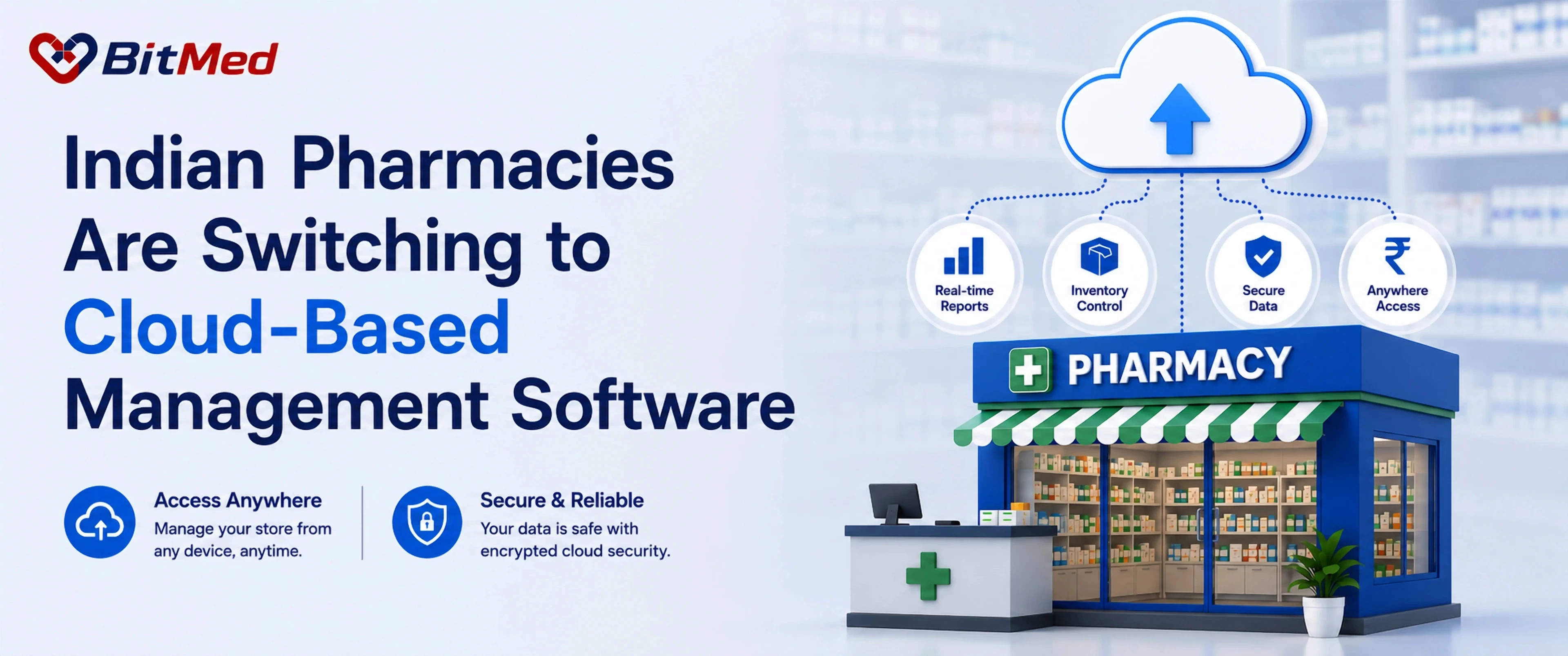
This article looks at the actual forces behind that shift across Indian pharmacy retail in 2026, rather than restating a feature list. For the direct feature-by-feature breakdown, see BitMed's comparison on Cloud-Based vs Offline Pharmacy Software; this piece is about the "why now," not the "what's different."
Driver 1: GST Compliance Has Gotten Harder to Manage Manually
GST filing requirements haven't gotten simpler since their introduction — accurate, time-stamped records are now expected as standard practice, not an occasional audit requirement. Pharmacies running on desktop software with periodic backups, or manual registers with no digital trail at all, increasingly find month-end filing takes longer each year as scrutiny and expectations rise.
Cloud-based management software addresses this by keeping sales and purchase data structured for tax reporting continuously, rather than requiring a separate compilation exercise. This alone has pushed many owners to reconsider systems they'd used for years without complaint.
Driver 2: Pharmacy Chains Are Growing, and Desktop Software Doesn't Scale With Them
A meaningful share of Indian pharmacy growth in recent years has come from existing owners opening a second or third location, rather than entirely new entrants. Desktop software, built around one machine at one counter, has no natural way to give an owner visibility across multiple branches — each store effectively becomes its own island of data.
Cloud-based systems solve this by design: one centralized catalog, real-time stock visibility across every branch, and consolidated reporting from a single dashboard. For owners actively expanding, this isn't a convenience — it's close to a requirement, which is why multi-store growth is one of the clearest drivers behind the cloud shift.
Driver 3: Owners Want Visibility Without Being Physically Present
A pharmacy owner running two counters, or splitting time between a store and other responsibilities, increasingly expects to check sales, stock, and alerts from a phone — not by calling a manager or visiting in person. Desktop and offline systems simply can't offer this, since data lives only on the machine it's installed on.
Cloud-based management software makes remote visibility the default, through dashboards and mobile owner apps, which is quickly becoming an expectation rather than a bonus feature for pharmacy owners managing more than one responsibility at a time.
Driver 4: Data Loss Risk Has Become Harder to Ignore
Desktop systems and manual registers share a common vulnerability: if the machine fails, is stolen, or the paper is damaged, years of sales, stock, and customer data can be gone with no recovery path — unless the store has maintained a disciplined, separate backup process, which many haven't.
As pharmacies have experienced this risk firsthand — or heard about it from other owners — cloud-based software's automatic, continuous backup has become a much more concrete selling point than it was a few years ago, when it was often treated as a nice-to-have.
Driver 5: Customer Expectations Around Speed Have Risen
Patients increasingly expect fast billing, quick medicine availability checks, and minimal waiting — pressure that's grown alongside the rise of quick-commerce medicine delivery and larger pharmacy chains competing on convenience. A slow, manual, or outdated billing counter now costs a pharmacy more in lost goodwill than it used to.
Cloud-based systems with fast, keyboard-first billing and real-time stock accuracy help independent pharmacies match this expectation without needing the scale of a large chain to do it.
Driver 6: Staff Turnover Makes Consistency Harder Without a System
Billing accuracy that depends on one trusted, experienced staff member is a real risk when that person leaves. Desktop or manual systems tend to carry tribal knowledge — shortcuts and workarounds one person knows — that doesn't transfer easily to a replacement.
Cloud-based software standardizes the billing process itself, so accuracy depends less on any one individual's memory or experience, and new staff can be brought up to speed faster with a consistent, guided workflow.
What This Shift Looks Like in Practice
Put together, these drivers explain a pattern showing up across Indian pharmacy retail: pharmacies aren't switching to cloud-based management software because of a single feature — they're switching because the accumulated weight of compliance pressure, growth ambitions, data risk, and customer expectations makes staying on desktop or manual systems progressively harder to justify.
- GST compliance: Before: manual reconciliation was tolerable. Now: filing expectations have tightened.
- Pharmacy chain growth: Before: single-store operations were the norm. Now: multi-branch expansion is increasingly common.
- Owner visibility: Before: in-person or phone-call checks were accepted. Now: remote, real-time visibility is expected.
- Data safety: Before: backup was often an afterthought. Now: data loss incidents have made the risk concrete.
- Customer expectations: Before: slower billing was tolerated. Now: speed and convenience shape loyalty.
- Staff consistency: Before: relied on experienced individuals. Now: systems need to standardize the process itself.
Where BitMed Fits This Shift
BitMed is built as cloud-based Pharmacy Management Software specifically for this transition — not as a desktop tool with cloud features bolted on, but as a system designed around real-time sync, multi-store visibility, and remote access from the ground up. Billing continues locally during a brief connectivity drop and syncs automatically once reconnected, so the operational safety net people associate with offline software — covered in BitMed's take on Offline Pharmacy Billing — is preserved without giving up any of the cloud-first benefits driving this broader shift.
Frequently Asked Questions
Why are Indian pharmacies moving to cloud-based software?
Primarily because of tightening GST compliance expectations, growing pharmacy chains that need multi-branch visibility, rising data-loss risk with desktop systems, and increasing customer expectations around billing speed — not because of any single feature.
Is this shift mainly happening among large pharmacy chains?
No. While chains are a clear driver, single-counter pharmacies are also switching, largely for GST compliance accuracy, data safety, and the ability for owners to check their business remotely.
Does switching to cloud-based software mean giving up reliability during internet issues?
Not with a well-built system. BitMed, for example, continues billing locally during a brief connectivity drop and syncs automatically once reconnected, so reliability isn't traded away for cloud benefits.
Is data safety really a bigger concern than it used to be?
Yes, largely because more pharmacies have experienced or heard about data loss from local hardware failure or theft, making automatic cloud backup a much more tangible benefit than it was treated as a few years ago.
How does cloud-based software help with pharmacy chain growth specifically?
It provides a centralized product catalog and real-time stock visibility across branches from day one, so opening a second or third location doesn't require rebuilding data systems from scratch at each site.
Does cloud-based software actually improve customer-facing speed at the counter?
Yes. Real-time stock accuracy and keyboard-first billing reduce the delays and errors that slow down a counter, directly affecting how fast customers are served.
Is switching to cloud-based software difficult for an existing pharmacy?
Generally not. Cloud-based platforms like BitMed run through a standard browser with no separate installation, and most of the transition effort is loading the product catalog and training staff on the new billing screen.
Conclusion
The move to cloud-based management software across Indian pharmacies isn't a single trend — it's the combined result of tighter compliance expectations, pharmacy chains outgrowing single-location systems, rising awareness of data-loss risk, and customers who expect faster, more reliable service. Desktop and manual systems built for an earlier, simpler retail environment increasingly can't keep up with all of this at once.
BitMed is built directly for this shift, as cloud-based Pharmacy Management Software with the operational resilience pharmacies still need during connectivity gaps. See how it fits where your pharmacy is headed at bitmed.in.
Is your pharmacy feeling the pressure to move to the cloud?
See how BitMed handles GST compliance, multi-store visibility, and remote access — without giving up billing reliability at bitmed.in.
Explore BitMed