
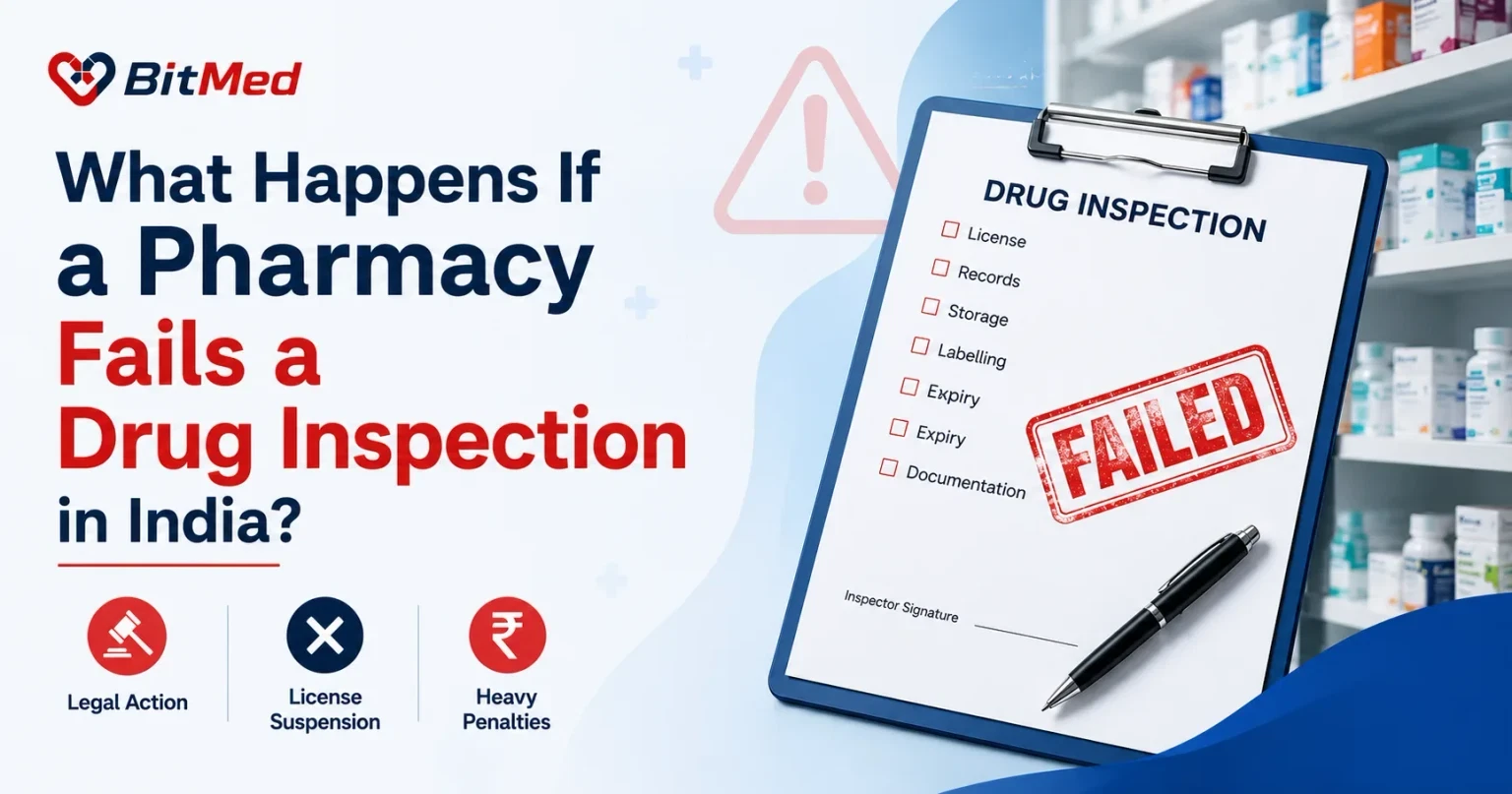
What Happens If a Pharmacy Fails a Drug Inspection in India?
Introduction
Drug inspections are a routine, expected part of running a licensed pharmacy in India — not a rare or alarming event reserved for problem stores. Every retail, wholesale, and composite pharmacy operating under a drug license can be inspected, and failing an inspection does not automatically mean the pharmacy closes down. What happens next depends heavily on the type and severity of the violation found.
This guide walks through the complete process — from how an inspection actually happens, to the specific consequences a pharmacy can face, to how a pharmacy owner can respond and recover if an inspection doesn't go well.
Quick answer: what happens if a pharmacy fails a drug inspection?
If a pharmacy fails a drug inspection in India, the Drug Inspector may issue observations, seize drugs, collect samples for testing, issue a show cause notice, recommend suspension or cancellation of the drug license, initiate prosecution for serious violations, or refer the matter for penalties under the Drugs and Cosmetics Act, 1940. Minor issues typically require corrective action and a follow-up inspection, while repeated or major violations can lead to license suspension, cancellation, and legal proceedings.
What Is a Drug Inspection?
A drug inspection is an official visit by a government-appointed Drug Inspector to verify that a pharmacy is operating in compliance with its license and applicable drug laws. Inspections generally fall into four categories:
- Routine inspections: Scheduled or periodic visits conducted as part of standard regulatory oversight.
- Surprise inspections: Unannounced visits, often used to get an accurate picture of day-to-day compliance.
- Complaint-based inspections: Triggered by a specific complaint from a patient, competitor, or member of the public.
- Follow-up inspections: Conducted after a previous violation, to verify that corrective action has actually been taken.
Inspections exist to protect public safety, ensure drug quality, verify legal compliance, and confirm that medicines are stored properly — particularly temperature-sensitive and restricted-schedule drugs.
Why Are Pharmacy Inspections Conducted?
Beyond the general goal of public safety, a typical pharmacy drug inspection checks several specific things:
- Whether the pharmacy holds a valid, current drug license.
- How medicines are stored, including temperature-sensitive stock.
- Whether expired medicines are present on the shelf.
- Handling of Schedule H, H1, and X drugs specifically.
- Whether prescriptions are being properly verified and retained.
- Purchase records and supplier invoices.
- Sales records and billing documentation.
- Cold chain compliance for vaccines, insulin, and similar drugs.
- Narcotic and psychotropic substance compliance.
- Whether a qualified Registered Pharmacist is actually present and available during operating hours.
Who Conducts Drug Inspections in India?
Drug inspections in India are primarily carried out by State Drug Inspectors, appointed and operating under the State Drug Control Administration (whose exact name varies by state; for example, in Madhya Pradesh it operates as the Food and Drugs Administration, Madhya Pradesh, overseen by the Controller, Food and Drugs Administration). The Central Drugs Standard Control Organisation (CDSCO) is involved in specific categories — such as certain imported drugs, new drug approvals, and matters with national or cross-state significance — but day-to-day retail pharmacy inspection is predominantly a state-level function.
Drug inspector powers under Section 22 of the Drugs and Cosmetics Act, 1940, include the authority to:
- Enter and inspect any premises where drugs are manufactured, sold, stocked, or distributed.
- Examine and require the production of records, registers, and documents.
- Take samples of drugs for testing.
- Search a person reasonably believed to be concealing drugs or cosmetics.
- Seize stock that appears to contravene the Act.
- Issue notices and orders relating to seized stock.
- Recommend prosecution for serious violations.
Willfully obstructing a Drug Inspector, or refusing to produce required records, is itself a punishable offense. Under Section 22(3) of the Act, obstruction can carry imprisonment of up to three years, a fine, or both.
Legal Framework Governing Drug Inspections
Three pieces of legislation form the core legal basis for pharmacy inspections and compliance in India:
- The Drugs and Cosmetics Act, 1940: The primary law regulating the import, manufacture, distribution, and sale of drugs and cosmetics, ensuring they meet quality and safety standards. It establishes the licensing framework and the powers of Drug Inspectors.
- The Drugs and Cosmetics Rules, 1945: The detailed operational rules under the Act — including the specific requirements for premises, storage, Schedule H/H1/X handling, and recordkeeping that inspectors check against during a visit.
- The Pharmacy Act, 1948: Governs the registration and regulation of pharmacists as professionals, separate from the drug-licensing framework itself. It's relevant during inspections because verifying that a genuinely Registered Pharmacist is employed and present is a standard inspection checkpoint.
Both State Drug Authorities and, where applicable, CDSCO oversee enforcement of these laws, depending on the nature and scope of the issue involved.
How Does a Pharmacy Drug Inspection Take Place?
While exact procedures can vary by state, a typical inspection generally follows this sequence:
- 1
Inspector arrives
The inspector arrives at the premises, generally during operating hours.
- 2
Identity verification
The inspector presents official identification confirming their appointment under the Act.
- 3
License verification
The pharmacy's drug license is checked for validity and correct category — retail, wholesale, or composite.
- 4
Stock inspection
Physical stock is reviewed, checking for expired medicines and proper categorization.
- 5
Storage inspection
Cold storage, general storage conditions, and any locked storage for restricted schedules (like Schedule X) are checked.
- 6
Invoice verification
Purchase invoices are cross-checked against stock on hand.
- 7
Prescription records
Records for Schedule H, H1, and X sales are reviewed for completeness.
- 8
Sample collection
Samples of specific drugs may be taken for laboratory testing, with a fair price tendered as required under the Act.
- 9
Inspection report
The inspector prepares a report documenting findings, which forms the basis for any follow-up action.
Common Reasons Pharmacies Fail Drug Inspections
| Violation | Severity | Possible consequence |
|---|---|---|
| Expired medicines on shelf | High | Notice / seizure |
| Selling without a valid prescription | High | Legal action |
| Improper storage conditions | Medium | Warning |
| Missing purchase bills / invoices | Medium | Compliance notice |
| Schedule H violations | High | Suspension |
| Missing / absent qualified pharmacist | High | License action |
| Missing temperature / cold-chain records | Medium | Warning |
| Unlicensed or unregistered medicines | High | Seizure |
| Incorrect or missing labeling | Medium | Notice |
| Poor general documentation | Low | Corrective action |
What Happens Immediately After a Failed Inspection?
The immediate aftermath depends on what was found, but typically follows one or more of these paths:
- Observation report: The inspector documents findings, even if no immediate action is taken.
- Warning letter: Issued for relatively minor, first-time, or easily correctable issues.
- Show cause notice: Formally requires the pharmacy to explain why action shouldn't be taken against the license.
- Drug sample collection: For suspected quality issues, requiring lab testing before further action.
- Drug seizure: Stock believed to violate the Act is seized pending investigation.
- Follow-up inspection: Scheduled to verify that corrective action has been completed.
- Investigation: For more serious or ambiguous violations requiring deeper review.
- Legal proceedings: Initiated for violations serious enough to warrant prosecution.
Minor vs Major Inspection Violations
| Minor non-compliance | Major non-compliance |
|---|---|
| Documentation errors | Sale of fake / spurious medicines |
| Record-keeping mistakes | Sale of expired drugs |
| Storage lapses | Illegal sale of Schedule X drugs |
| Small labeling issues | No qualified pharmacist present |
| Minor housekeeping issues | Sale of counterfeit medicines |
The distinction matters because it shapes the response: minor non-compliance generally results in a warning or compliance notice with an opportunity to correct the issue, while major non-compliance — particularly anything involving fake, expired, or improperly controlled drugs, or the complete absence of a required pharmacist — moves quickly toward license action and potential prosecution, since these issues carry direct public health risk.
Penalties for Failing a Drug Inspection
Consequences generally fall into four categories:
- Administrative actions: A formal warning, a compliance notice requiring specific corrective steps, or an order for reinspection.
- License actions: Suspension of the drug license for a defined period, or in serious or repeated cases, cancellation of the license entirely.
- Legal actions: Fines, court proceedings, and prosecution under the relevant provisions of the Drugs and Cosmetics Act, 1940. Offenses involving spurious or adulterated drugs, particularly those causing harm, carry substantially more severe consequences than administrative or documentation lapses. Willful obstruction of a Drug Inspector, for example, is punishable under Section 22(3) with imprisonment of up to three years, a fine, or both.
- Drug seizure and product recall: Stock found to be non-compliant can be seized, and in cases affecting a wider batch or supply chain, a product recall may be ordered.
Penalty provisions under both the Drugs and Cosmetics Act and the Pharmacy Act have been amended over time — including the Jan Vishwas (Amendment of Provisions) Act, 2023 and the Jan Vishwas (Amendment of Provisions) Act, 2026, which adjusted fine amounts and decriminalized certain minor offenses — so confirm current, exact penalty figures with a legal professional rather than relying on older published figures.
Can a Drug License Be Suspended or Cancelled?
Yes. A drug license can be suspended or cancelled by the licensing authority, typically for reasons including:
- Repeated violations found across multiple inspections.
- Sale of fake or spurious medicines.
- Selling drugs without a valid license or outside the license's scope.
- Misuse or mishandling of Schedule drugs, particularly Schedule H1 and X.
- Violations that pose a direct public health risk.
The drug license suspension process generally involves a show cause notice giving the pharmacy an opportunity to respond, followed by a decision from the licensing authority based on the severity and pattern of violations. Cancellation is typically reserved for serious, repeated, or willful violations rather than a single minor lapse.
Rights of Pharmacy Owners During an Inspection
Pharmacy owners aren't without recourse during an inspection. Generally recognized rights include:
- Verifying the inspector's identity and official authorization before the inspection proceeds.
- Receiving a copy of the inspection report documenting what was found.
- The right to explain circumstances around any observed issue.
- The right to respond formally to any notice issued.
- Appeal rights against license suspension or cancellation decisions, through the appropriate administrative or legal channel.
- Legal representation, particularly once a matter moves toward a show cause notice or prosecution.
How Should a Pharmacy Respond After Failing an Inspection?
- 1
Read the inspection report
Go through it carefully to understand exactly what was flagged.
- 2
Separate urgent from minor
Identify each violation and separate genuinely urgent issues from minor documentation gaps.
- 3
Correct issues immediately
Wherever possible — removing expired stock, fixing storage conditions, completing missing records.
- 4
Prepare supporting documentation
Gather evidence of any corrective action taken.
- 5
Respond within the deadline
Reply to any notice within the required timeframe, rather than letting a deadline lapse.
- 6
Cooperate with follow-up
Cooperate fully with any follow-up inquiry or investigation.
- 7
Request a reinspection
Ask for a reinspection once corrective action is complete, where applicable.
- 8
Keep records of everything
Maintain records of the entire process, including communications with the licensing authority.
How to Avoid Failing Future Drug Inspections
- Pay the five-year licence retention fee before it falls due — the licence itself no longer expires, but a missed retention deadline cancels it.
- Remove expired medicines from shelves proactively, not reactively.
- Maintain complete, organized purchase invoices.
- Keep accurate temperature and cold-chain logs.
- Maintain batch-wise tracking for all stock.
- Ensure a qualified Registered Pharmacist is genuinely present during operating hours.
- Maintain the Schedule H prescription register, plus the Schedule H1 (and, where applicable, Schedule X) register, accurately.
- Keep the premises clean and organized.
- Train staff regularly on compliance requirements.
- Conduct regular internal compliance audits, rather than waiting for an official inspection to surface issues.
Several of these — batch tracking, expiry visibility, and the Schedule H1 register in particular — are exactly the areas where a dedicated Pharmacy Management Software platform like BitMed removes manual dependency, since batch and expiry data is captured automatically at purchase and the H1 register opens on its own at billing, rather than relying on a staff member to remember each step.
Pharmacy Inspection Compliance Checklist
A quick reference across the areas inspectors typically review:
- License: Current, valid, and matching the pharmacy's actual operations (retail / wholesale / composite).
- Storage: Appropriate conditions, including air conditioning and cold storage where required.
- Documentation: Purchase invoices, sales records, and licensing paperwork organized and accessible.
- Inventory: No expired stock, accurate batch tracking.
- Schedule drugs: H1 register maintained accurately; Schedule X stored under lock and key with its own register.
- Cold storage: Functioning refrigeration with monitored temperature logs.
- Fire safety: Basic fire safety compliance for the premises.
- Staff: A genuinely Registered Pharmacist present during operating hours.
- Billing: GST-compliant, accurate billing records.
- Prescription records: Properly verified and retained according to schedule-specific requirements.
Most of this checklist comes down to one underlying requirement: records that are accurate and readily available the moment an inspector asks for them. This is the specific gap a cloud-based Pharmacy Management Software platform like BitMed is built to close — keeping billing, batch, expiry, and Schedule H1 records connected and audit-ready by default, rather than assembled manually before an inspection.
Frequently Asked Questions
What happens if a pharmacy fails a drug inspection?
Depending on severity, outcomes can range from a warning or compliance notice for minor issues, to drug seizure, license suspension, cancellation, or prosecution for serious or repeated violations.
Can a pharmacy be closed after an inspection?
Yes, in serious cases — if the drug license is suspended or cancelled following major violations, the pharmacy cannot legally continue operating drug sales until the license is reinstated or a new license is obtained.
How often are pharmacies inspected in India?
Frequency varies by state and pharmacy risk profile, and can include both scheduled routine inspections and unannounced surprise inspections, in addition to complaint-triggered visits.
What powers does a Drug Inspector have?
Under Section 22 of the Drugs and Cosmetics Act, 1940, a Drug Inspector can inspect premises, examine and require production of records, take samples, search a person reasonably suspected of concealing drugs, seize non-compliant stock, and recommend prosecution.
Can a pharmacy appeal against license suspension?
Yes. Pharmacy owners generally have the right to appeal a suspension or cancellation decision through the appropriate administrative or legal channel, and legal representation is advisable once a matter reaches this stage.
What documents should be available during an inspection?
Typically the current drug license, purchase invoices, sales records, the Schedule H1 (and Schedule X, if applicable) register, pharmacist registration proof, and cold-chain / temperature logs where relevant.
What is the penalty for selling expired medicines?
This is treated as a high-severity violation that can result in seizure of the stock, a notice or show cause proceeding, and — depending on the pattern and scale — license suspension or prosecution under the Drugs and Cosmetics Act. Exact penalty figures should be confirmed against current law, as these provisions have been subject to amendment.
What is the difference between the Drugs and Cosmetics Act and the Pharmacy Act?
The Drugs and Cosmetics Act, 1940 regulates the licensing, quality, and sale of drugs and cosmetics themselves. The Pharmacy Act, 1948 separately regulates the registration and professional conduct of pharmacists. An inspection can involve both — checking the drug license under one law and verifying the pharmacist's registration under the other.
What is Section 42 of the Pharmacy Act?
Section 42 restricts the compounding, preparing, mixing, or dispensing of medicine on a medical practitioner's prescription to Registered Pharmacists only, once the relevant state notification bringing the section into force has been issued. Contravention is punishable with imprisonment of up to three months, or a fine of up to ₹2,00,000, or both — figures substituted by the Jan Vishwas (Amendment of Provisions) Act, 2023, whose Pharmacy Act amendments were notified on 13 June 2025.
What is Section 43 of the Pharmacy Act?
Section 43 deals with the failure to surrender a certificate of registration after a pharmacist's name has been removed from the register — for example, following disciplinary action. As it currently stands it carries a fine of up to ₹50, and cognizance of an offence under this section requires a complaint made by an order of the Executive Committee of the State Council. The Jan Vishwas (Amendment of Provisions) Act, 2026 replaces this with a penalty of up to ₹5,000 payable within ten days, plus ₹1,000 for each day the contravention continues, adjudicated under Section 43A — those changes take effect on a date the Central Government notifies.
How can someone file a complaint against a pharmacy in India?
Complaints are generally filed with the relevant State Drug Control Department (such as the Food and Drugs Administration in Madhya Pradesh) or the State Pharmacy Council, depending on whether the complaint concerns drug licensing / quality issues or a pharmacist's professional conduct. The complaint typically triggers a review and, where warranted, a complaint-based inspection.
Conclusion
Drug inspections exist to protect public health, not to catch pharmacies out unnecessarily. Minor issues — documentation gaps, small storage lapses — are generally handled through corrective action and follow-up review. Serious or repeated violations, particularly anything involving expired, fake, or improperly controlled Schedule drugs, or the absence of a qualified pharmacist, carry real consequences up to license suspension, cancellation, and prosecution.
The single most reliable way to reduce inspection risk is consistency: accurate documentation, proper storage, valid licensing, and genuine day-to-day compliance — not a scramble before a scheduled visit. For many pharmacies, that consistency is easier to maintain with a Pharmacy Management Software platform like BitMed handling billing, inventory, and Schedule H1 recordkeeping automatically, rather than depending entirely on manual registers and staff memory.
If you want to audit your own file before someone else does, our compliance checklist walks through the records an inspector asks for first, mapped to the rule that requires each one.
Stay inspection-ready, not inspection-anxious
See how BitMed supports GST-compliant billing, batch tracking, and Schedule H1 recordkeeping for Indian pharmacies at bitmed.in.
Explore BitMed