
Pharmacist Registration vs Drug License: What's the Difference?
Quick Answer
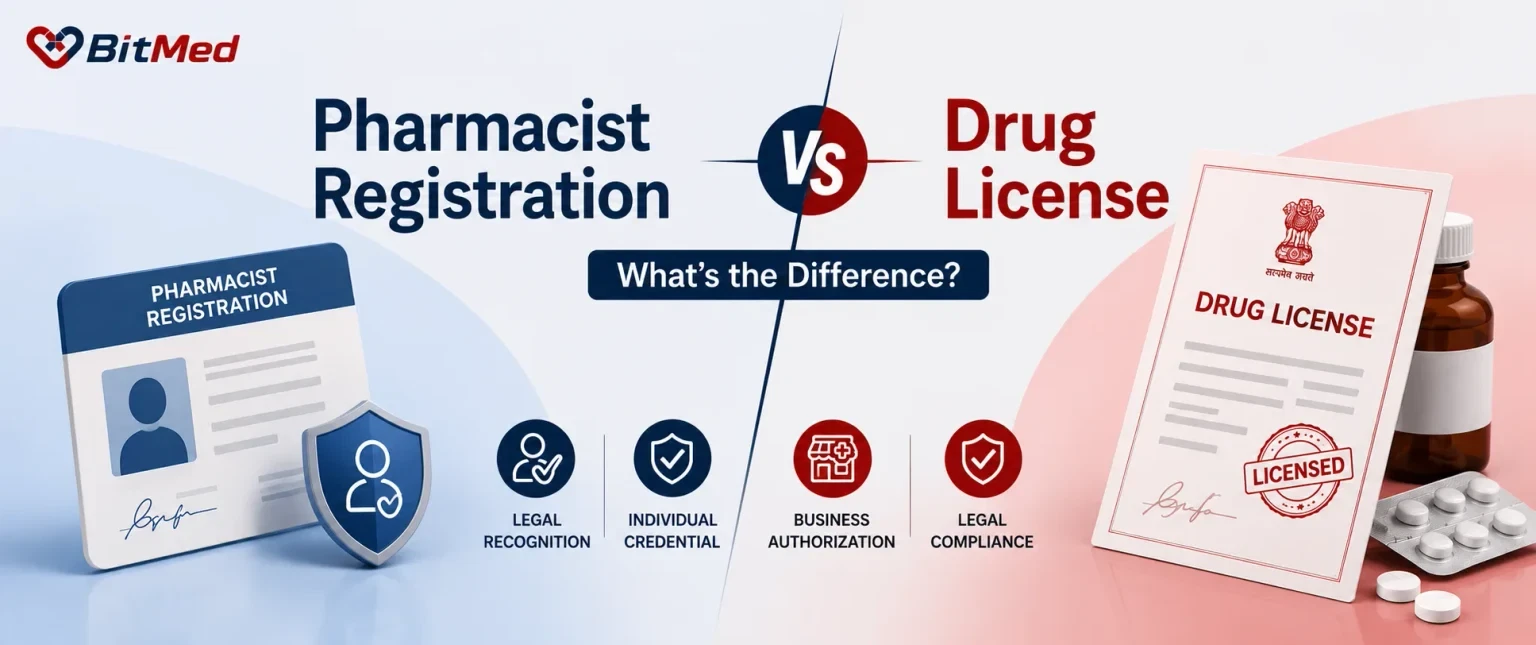
Pharmacist Registration is a personal, professional credential — issued by a State Pharmacy Council under the Pharmacy Act, 1948, to an individual who has completed a recognized pharmacy qualification. It certifies a person, moves with them wherever they work, and never belongs to a business.
A Drug License is a commercial authorization — issued by a State Drug Licensing Authority under the Drugs and Cosmetics Act, 1940, to a specific business at a specific address. It certifies premises and infrastructure, not a person, and does not transfer if the business relocates.
A retail pharmacy typically needs both at once: a valid Drug License for the shop, and a Registered Pharmacist physically present to run it. Neither one substitutes for the other.
Why This Confusion Happens
New pharmacy owners often assume "getting licensed" is a single step, because the pharmacist and the license both show up at the same counter, in the same shop, on the same day it opens. In reality, they come from two separate laws, two separate regulators, and two separate approval processes that simply happen to intersect at that counter.
The Two Governing Laws
The Pharmacy Act, 1948 regulates the person — education, credentialing, and professional registration of pharmacists. It established the Pharmacy Council of India (PCI) to set minimum qualification standards (like D.Pharm and B.Pharm curricula) and created State Pharmacy Councils to actually register individual pharmacists. Section 42 of this Act makes it an offense for anyone other than a Registered Pharmacist to compound, prepare, or dispense medicine on a doctor's prescription.
The Drugs and Cosmetics Act, 1940, along with the Drugs and Cosmetics Rules, 1945, regulates the business — the import, manufacture, storage, distribution, and sale of drugs and cosmetics. This is the law that requires a Drug License before a pharmacy, distributor, or manufacturer can legally operate.
Side-by-Side Comparison
| Aspect | Pharmacist Registration | Drug License |
|---|---|---|
| What it certifies | A person's professional competence to handle and dispense drugs | A business's premises and infrastructure for stocking/selling drugs |
| Governing law | Pharmacy Act, 1948 | Drugs and Cosmetics Act, 1940 & Rules, 1945 |
| Issuing authority | State Pharmacy Council | State Drug Licensing Authority (State FDA / Drug Control Department) |
| Attached to | The individual, permanently | The specific business premises/address |
| Transferable? | Yes — moves with the person to any employer | No — tied to that location; a new address needs a new license |
| One without the other | A qualified pharmacist can't legally dispense from an unlicensed shop | A licensed shop can't legally operate without its required pharmacist present |
Pharmacist Registration: How It Actually Works
To become a Registered Pharmacist, a candidate generally needs:
- 10+2 education with Physics, Chemistry, and Biology or Mathematics.
- A recognized Diploma in Pharmacy (D.Pharm), Bachelor of Pharmacy (B.Pharm), or higher qualification from a PCI-approved institution.
- Practical training completed as required under the Pharmacy Practice Rules.
Registration itself happens at the state level, through the State Pharmacy Council of the state where the individual intends to practice — not through a single central application. Many states have moved this process online. Madhya Pradesh's State Pharmacy Council, for example, runs registration and renewal through a paperless portal that verifies identity via Samagra ID and delivers registration certificates through DigiLocker, removing the need for physical office visits or document submission in most cases. States vary in exactly how digitized this process is, so it's worth checking your specific State Pharmacy Council's current process rather than assuming a uniform national system.
Once granted, this registration belongs entirely to the individual — it stays valid regardless of which pharmacy employs them, and it's the credential a pharmacy owner must verify and keep on file for whichever pharmacist they employ.
Drug License: How It Actually Works
A Drug License is issued per business, per location, by the relevant State Drug Licensing Authority, and comes in different forms depending on what the business actually does:
- Form 20: Retail sale of general drugs (excluding Schedule C, C1, and X).
- Form 21: Retail sale of Schedule C and C1 drugs (biologicals, vaccines, sera, and other cold-chain-sensitive products).
- Form 20B / 21B: Wholesale equivalents of the above.
- Composite License: Combines retail and wholesale permissions for businesses doing both from one premises.
There's also a lesser-known but genuinely important category directly relevant to this comparison, and state drug control departments set out its scope form by form.
Form 20A / 21A — the "no pharmacist required" restricted license
These are restricted licences for dealers who do not employ a Registered Pharmacist — typically granted in rural areas or villages where a registered pharmacist isn't reasonably available, or for itinerant vendors. In exchange, the product scope is cut back. Form 20A covers retail sale of drugs other than those specified in Schedules C, C(1) and X. Form 21A covers retail sale of drugs specified in Schedule C(1), but excluding those in Schedule X. So Schedule X is the line neither restricted form crosses — those drugs always need a Registered Pharmacist. This is the clearest real-world illustration of how these two systems interact: where the personnel requirement is relaxed, the product scope is deliberately narrowed to compensate.
For the full breakdown of license categories, space requirements, and the application process, see Types of Drug Licenses in India: Retail vs Wholesale vs Composite.
Where the Two Requirements Meet: Personnel Rules
This is the point where pharmacist registration and drug licensing directly intersect, and the rules differ meaningfully by license type:
- Standard retail license (Form 20/21): A Registered Pharmacist is a strict, non-negotiable requirement, physically present during all operating hours. If no registered pharmacist is present — no backup, no exception — the pharmacy cannot legally dispense medicines that day.
- Wholesale license (Form 20B/21B): Because wholesale deals in sealed, bulk stock rather than dispensing against individual prescriptions, the rules allow more flexibility — the premises can be managed by either a Registered Pharmacist or a "Competent Person," defined under the Drugs and Cosmetics Rules as a graduate with at least one year of documented, verifiable experience handling drugs in a wholesale or manufacturing setup.
- Composite license: Because retail sales to patients are involved, this flexibility disappears — a Registered Pharmacist is mandatory, the same as a pure retail license.
- Restricted license (Form 20A/21A): No Registered Pharmacist required at all, but the product range is narrowed in exchange. Form 20A drops drugs specified in Schedules C, C(1) and X; Form 21A permits the Schedule C(1) drugs that Form 20A leaves out, but still stops short of Schedule X. Neither restricted form covers Schedule X drugs.
What Happens If You Get This Wrong
The consequences aren't symmetrical, and both directions carry real risk.
Operating with a valid Drug License but no Registered Pharmacist present (where one is required) means the pharmacy cannot legally dispense — this is treated as operating outside the conditions of the license itself, and it is one of the things a drug inspector checks first.
A Registered Pharmacist dispensing from premises without a valid Drug License falls under the Drugs and Cosmetics Act's penalty provisions. Selling or distributing drugs without the required license under Section 27(b)(ii) carries imprisonment of not less than three years, extendable to five, along with a fine of not less than ₹1 lakh or three times the value of the drugs confiscated — whichever is more. Courts retain limited discretion to reduce this in specific circumstances, but the baseline penalty is severe by design.
Licence forms, personnel conditions, and penalty figures are set by the Drugs and Cosmetics Rules and amended over time — including by the Jan Vishwas (Amendment of Provisions) Acts of 2023 and 2026. State Pharmacy Councils and State Drug Licensing Authorities also differ in process. This is general information, not legal advice; confirm current requirements with your state authority.
Neither credential compensates for the absence of the other. A pharmacy owner needs to treat both as independently mandatory, not as a single combined checkbox.
Common Misconceptions
- "My Drug License means I'm automatically compliant on staffing.": No — the license and the pharmacist's registration are maintained and verified completely separately: the registration is renewed periodically, while the drug licence is kept alive by a five-year retention fee. A lapsed pharmacist registration can put a fully licensed pharmacy out of compliance overnight.
- "A pharmacist's registration from one state works everywhere.": Registration is state-specific. A pharmacist relocating to practice in a different state generally needs to register with (or transfer their registration to) that state's Pharmacy Council.
- "Form 20A/21A is just a cheaper version of Form 20.": It isn't a discount tier — it's a specific tradeoff: no pharmacist required, but a meaningfully narrower range of drugs permitted.
- "The business owner needs to be a pharmacist.": Not necessarily — the proprietor can be a non-pharmacist, provided a Registered Pharmacist is properly employed, with their consent and appointment documented as part of the license application.
Frequently Asked Questions
Is a Drug License the same as Pharmacist Registration?
No. A Drug License authorizes a business at a specific location to sell or distribute drugs, under the Drugs and Cosmetics Act, 1940. Pharmacist Registration certifies an individual's professional competence to dispense medicine, under the Pharmacy Act, 1948. A pharmacy generally needs both, from two different authorities.
Can a pharmacy operate with a Drug License but no Registered Pharmacist?
Not if it's a standard retail (Form 20/21) or composite license — a Registered Pharmacist must be physically present during operating hours, with no exceptions for absence. Only a restricted license permits operation without one, and only over a narrower product range: Form 20A covers drugs other than those specified in Schedules C, C(1) and X, while Form 21A covers drugs specified in Schedule C(1) but excluding Schedule X.
Does a wholesale drug license require a Registered Pharmacist?
Not necessarily. A wholesale license can be managed by either a Registered Pharmacist or a "Competent Person" — a graduate with at least one year of documented drug-handling experience — since wholesale doesn't involve dispensing against individual prescriptions.
Is pharmacist registration valid across all Indian states?
Registration is granted by a specific State Pharmacy Council. A pharmacist moving to practice in another state typically needs to register with or transfer their registration to that state's council rather than assuming automatic nationwide validity.
What's the penalty for selling drugs without a valid drug license?
Under Section 27(b)(ii) of the Drugs and Cosmetics Act, 1940, this carries imprisonment of not less than three years (extendable to five) and a fine of not less than ₹1 lakh or three times the value of the drugs confiscated, whichever is more. Penalty provisions have been amended over time — including by the Jan Vishwas (Amendment of Provisions) Acts of 2023 and 2026 — so confirm the current figures rather than relying on older published ones.
What is a "Competent Person" under drug licensing rules?
A Competent Person is a graduate with at least one year of documented, verifiable experience handling drugs in a wholesale or manufacturing setup — an alternative to employing a Registered Pharmacist, but only for wholesale licenses, not retail or composite.
Why would a pharmacy apply for Form 20A/21A instead of Form 20/21?
Typically because a Registered Pharmacist isn't available — common in rural or underserved areas. The tradeoff is a narrower product range. Form 20A excludes drugs specified in Schedules C, C(1) and X. Form 21A adds back the Schedule C(1) drugs, but Schedule X drugs remain outside both restricted forms.
Conclusion
Pharmacist Registration and a Drug License solve two different problems: one certifies a qualified human being, the other certifies a compliant business premises. They're issued by different authorities, under different laws, on different timelines — and a pharmacy needs both, maintained independently, to operate legally. The clearest proof of how deliberately these two systems are designed to work together is Form 20A/21A: the one license category that explicitly trades pharmacist-free operation for a narrower, safer range of medicines.
For the complete picture on drug license categories and the application process, see Types of Drug Licenses in India, and for the wider compliance landscape — GST, recordkeeping, and controlled substances — see the complete pharmacy drug licensing and compliance guide.
Keeping license status and pharmacist credentials straight — alongside GST, inventory, Schedule H1 compliance, and the narcotic drug register where controlled substances are stocked — is easier with a system built to track it all in one place.
One licence, one pharmacist, one system of record
See how BitMed's Pharmacy Management Software supports compliant, audit-ready pharmacy operations at bitmed.in.
Explore BitMed